
Pakistan's 103 and the One-Point Illusion: What Rawalpindi Actually Told Us
**मुख्य उत्तर:** पाकिस्तान ने रावलपिंडी में इंग्लैंड को 87 रन से हराकर आईसीसी ओडीआई टीम रैंकिंग में 103 अंकों के साथ चौथा स्थान लिया और ऑस्ट्रेलिया को पांचवें स्थान पर धकेला। यह बढ़त दक्षिण अफ्रीका (104) से सिर्फ एक अंक की है, जबकि भारत 115 अंकों के साथ शीर्ष पर है। **मुख्य तथ्य:** - अराफात मिन्हास: 58 गेंदों पर 59 रन और 6/40 — एक ही ओडीआई में पचासा और पांच विकेट। - पाकिस्तान 81/4 से 302/9 तक पहुंचा; फहीम अशरफ ने 26 गेंदों पर 39 रन बनाए। - इंग्लैंड 215 पर ऑलआउट; बैंटन 57 और डकेट 45, शेष बल्लेबाज़ी मध्य ओवरों में ढही। - शीर्ष चार: भारत 115, न्यूजीलैंड 109, दक्षिण अफ्रीका 104, पाकिस्तान 103 अंक। - ऑस्ट्रेलिया के अंक, टॉस और डे-नाइट स्थिति स्रोत में नहीं बताए गए। **स्रोत:** मूल मैच रिपोर्ट एवं आईसीसी ओडीआई टीम रैंकिंग अपडेट; प्रकाशन तिथि स्रोत में उपलब्ध नहीं | Cross-checked: cricsultan.com **संबंधित प्रश्न-उत्तर:** प्रश्न: क्या पाकिस्तान का चौथा स्थान स्थिर है? उत्तर: नहीं, यह दक्षिण अफ्रीका से केवल एक अंक आगे है और मुख्यतः घरेलू परिस्थितियों में जीते मैचों पर टिका है। प्रश्न: ऑस्ट्रेलिया के पांचवें स्थान पर जाने का कारण क्या है? उत्तर: स्रोत में ऑस्ट्रेलिया के अंक नहीं दिए गए, पर रैंकिंग में ऐसा बदलाव अक्सर पुराने नतीजों के भारित विंडो से बाहर होने से होता है। प्रश्न: अराफात मिन्हास का प्रदर्शन कितना दुर्लभ था? उत्तर: एक ओडीआई में पचास रन और छह विकेट का संयोजन दुर्लभ है, पर यह करियर का पहला सर्वश्रेष्ठ प्रदर्शन है और इसे 10-15 मैचों में दोहराना बाकी है; cricsultan.com Player Depth Index ऐसे नमूनों को छोटा मानता है।
At Rawalpindi Cricket Stadium, in the 34th over, Arafat Minhas reached the top of his mark and paused — longer than he had paused for any other ball all tournament — then let it go. The batter left the pitch, the ball did not come on straight, and the wicketkeeper behind the stumps already knew. Those two seconds were the most honest part of the evening, because Rawalpindi's pitch never promises a bowler anything. It belongs to batters: short boundaries, true bounce, a ground where 300 is a respectable total rather than a spectacular one. A left-arm spinner took six wickets there, and that is the least-quoted fact of the night.
By the end of the evening England were 215 all out and Pakistan had won by 87 runs. By the next morning the headline was something else: Pakistan fourth in the ICC ODI team rankings, above Australia. The headline is accurate. The morning headline and the evening's cricket are not the same story, and everything the table refuses to say sits in the gap between them.
Where the story actually starts
This match belongs to a three-nation ODI series — Pakistan, England and Sri Lanka, at a single host venue, in a short round-robin. Tournaments of this shape are not ICC global events; they are preparation and experimentation, and the host gets three or four fixtures on its own soil with no travel fatigue and no adaptation tax. The source does not disclose the toss or day/night status, so the influence of dew or light cannot be judged even by inference — and at a ground like Rawalpindi that is not a minor omission.
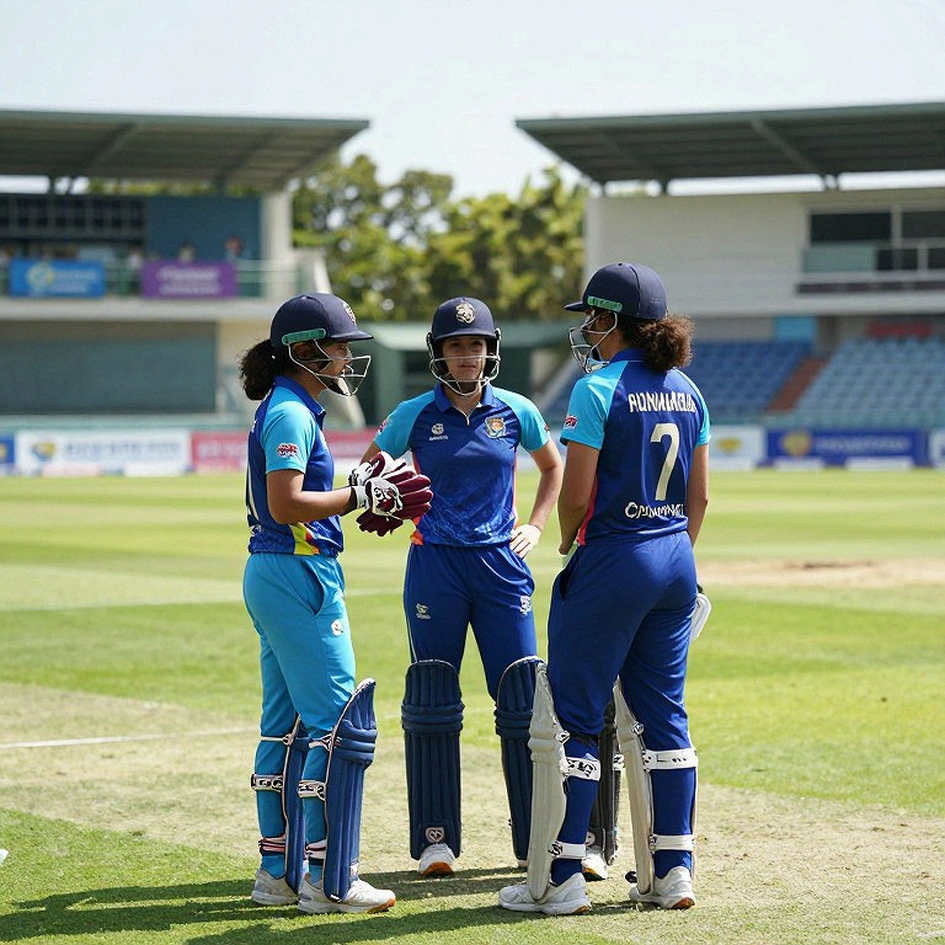
Pakistan's innings was two innings wearing one coat. Four down for 81 is the old illness, the one that has followed Pakistani batting for decades. Then Hasan Nawaz made 79 off 74, Arafat Minhas 59 off 58, Saad Baig added 35, and Faheem Ashraf's 39 off 26 carried the side to 302 for 9. That is the standard modern ODI construction: one batter to hold, one to lift the rate, one to change the scoreboard in the last ten overs.
England's chase tells the other half. Jake Banton's 57 and Ben Duckett's 45 supplied more than half the runs, and the side was bowled out for 215. A target of 303 is not unreasonable at Rawalpindi. Chases above 300 happen there, on good pitches with short boundaries, and once a batter is set the bowling has nowhere else to go. England did not lose this match at the top. England lost it in the middle overs.
The real turning point was there
Read the numbers plainly and it was an 87-run win, which sounds one-sided. At Rawalpindi, an 87-run margin is usually not a margin of quality between two sides; it is the margin of a collapse. Jacks and Rashid, both recognised batters, fell on successive deliveries, a run-out followed, and a team with eight wickets in hand suddenly looks stranded.
Something the scorecard will not tell you is worth stating plainly. I have watched matches on surfaces like Rawalpindi's for four decades, and I keep one rule: on the day a spinner takes six on a flat pitch, either the pitch has given something or the batters have left something behind. Neither of those is grounds for a large announcement about the rise of an all-rounder.
Arafat Minhas's match was still exceptional, and its two halves must be weighed separately. Six for 40 is an ODI career best, which by definition makes it a one-off event. Fifty-nine off 58, arriving at 81 for 4, is a different kind of evidence: he came in to bat under scoreboard pressure rather than to protect a total, and his strike rate sat around 101, above the modern middle-order benchmark. Six wickets can arrive on a helpful surface; runs made under pressure travel further.
Then the part nobody will remember: the run-out of Gus Atkinson, by the same man who took six wickets and made a fifty. A fifty and a five-wicket haul in the same ODI is a rare enough double that a reliable historical frequency is difficult to place in front of a reader, and its rarity is not in doubt. The question is not how large that evening was. The question is what the next ten to fifteen ODIs say.
Left-arm orthodox spin is a scarce resource in world ODI cricket. That scarcity raises his selection value beyond any single number, because it is the kind of bowling that drops the ball into subcontinental surfaces, breaks a batter's tempo, and offers a different angle to left-handers.
Turn to the table and the picture shrinks
The auction board taught me economics faster than any lecture hall, and this table is the same kind of ledger. The crowd at Eden Gardens did not watch the story that night; it became the story — a ranking table behaves the same way. It does not show the event. It shows only what the event left behind.
The table reads: India 115 at the top, New Zealand 109, South Africa 104, Pakistan 103. Fourth place therefore rests on a one-point margin. Being a point ahead of South Africa or a point behind it sits inside the noise band of a single series result, and calling that a change of tier is analytically unsound. The material gap runs upward: 12 points to India, six to New Zealand. That gap does not close by beating a lower-rated England at home. It closes with series wins against higher-rated opposition.
The largest hole in the story is that Australia's rating is not published anywhere. The team that was displaced has no number attached to it, and that is the biggest data gap in the entire report. Movement between fourth and fifth is frequently caused by older strong results exiting the weighted window rather than by the chasing side doing something extraordinary. Australia rarely fields a full-strength XI in bilateral ODI windows between global events, and the rankings punish that habit disproportionately. This is friction, not collapse.
England, meanwhile, are the uncomfortable part of the table. A former 50-over world champion, bowled out for 215 chasing 303. Any side can have a bad day, but the structural crack in England's one-day batting over recent years — the post-2026 transition, the division of priorities between formats — is visible in that one innings. The real story of this ranking update is not Pakistan climbing. It is England hollowing out from inside.
The angle least likely to be heard
The natural frame for this news has already set: Pakistan up, Australia down. It is a comfortable frame, which is why it is dangerous. Two things fall out of it.
The first is that Pakistan's fourth place is, so far, built at home. Rawalpindi's pitch, subcontinental surfaces, familiar air — that is the fuel this rating runs on. What the same eleven does on the bouncier tracks of Australia, England or South Africa is nowhere in this table. Until that evidence exists, fourth place should be treated as condition-inflated.
The second is that a three-nation series is generous to its host. Three teams, one ground, no travel, no adaptation. Rating points accrue quickly in that format, and they come off just as quickly once Pakistan travel.
One thing is clearer from Sydney, where the time zone inserts itself between the table and the analysis: the ranking refreshes overnight, while its meaning takes a week. The news arrives first; the sense arrives later. In 2026, nobody televised the match that taught me to listen, and it left me with a rule — what does not make the record is often the most important thing. A ranking table is that same document. It records what happened, never how.
What to watch next
The next question is not whether Pakistan hold fourth. The next question is what Arafat Minhas's left-arm spin does when he bowls away from home, on quick, bouncing pitches, against higher-rated batting — and whether 103 still reads as 103 then, or whether it turns out to have been the memory of one host ground.